On the distance

Beyond the sunset on the west

Category: Journal

The unseen truth

Monterrey, March 2010

Through life, people tend to focus on what’s near them. They move forward without noticing the crude reality that surrounds them, as if they were horses with blinders following whatever direction the carriage pulls them toward. I was no different. My life drifted without major worries or real problems, deaf to the noise that filled the news and social media. My concerns were trivial; chasing girls at the club, getting drunk at some frat party. I thought that was life; simple, harmless, endless. But reality creeps closer without sound; it waits until it’s too obvious to ignore. Deep down, though, you always know it’s there.

It was late, and the afterparty wasn’t good enough. My throat was dry, the booze was running out, and the pretty brunette I’d spent the whole night talking to wouldn’t give me more than a kiss. Disappointing, but fair. The yuppie friend hosting the afterparty bored me, and it was time to call it a night. My car was parked a few blocks away, and to my drunk self, the idea of walking didn’t seem so bad.

The sky was still dark as I left the apartment complex. The main street was silent, except for a few distant dog barks and the faint rustle of leaves touched by the dawn’s first breeze. I walked without thinking, without caring. My consciousness drifted, blurred by alcohol and fatigue, and for a brief moment, that numbness silenced the questions that usually haunted me who I was, what I was doing questions that never had clear answers anyway.

A block later, I saw it: a black Jeep with tinted windows parked in front of an old abandoned building. Two men stood by it, smoking. Something about them felt wrong. I looked away and kept walking; a fool pretending not to notice.

One of them turned.

“Hey, man, come here and help us with something!” he shouted.

He wore an oversized white shirt, baggy black pants, Jordans, and a Yankees cap straight out of a cliché, but clichés exist for a reason.

“Sorry, man, I’m in a hurry,” I replied, quickening my pace.

He started walking toward me, saying something else, but I didn’t wait to listen I ran.

Two blocks ahead, I saw a police checkpoint. Salvation, or so I thought. I ran harder, my mind sobering with the rush of adrenaline. For an instant, I believed it was over. Then the Jeep roared beside me, tires screeching, cutting me off. The same guy stepped out, shouting:

“I told you to come here, motherfucker!”

He didn’t show a gun or a knife, but I didn’t need to see one to know what came next. I turned and ran again.

All the violence I had heard about the kidnappings, the killings, the disappearances suddenly took shape. It was no longer a story told by someone else. It was here, breathing down my neck. I waved frantically at the road, begging for someone to stop. A taxi did. I jumped in and told the driver to head toward the university; campus security was nearby. For a moment, I thought I’d made it.

Then the Jeep pulled alongside us. Through the window, one of the men yelled at the driver:

“Stop if you don’t want trouble! We just want that bastard!”

Without hesitation, the driver stopped. He didn’t look at me and just unlocked the doors.

“Please, man,” I begged. “The police station’s close. Just drive.”

He met my eyes in the rearview mirror. There was sorrow there, but also fear.

“Sorry, mate. I can’t risk any trouble.”

The men stepped out of the Jeep, moving toward us. My heart pounded, and I knew if they got me, it wouldn’t end well. Fear sharpened my will. I threw the door open, slamming it against one of them, and ran. Ahead, I saw the guard post of an apartment building. A man stood outside, smoking.

“Let me in! Call the police! it’s an emergency!” I screamed.

He hesitated but opened the gate. I rushed inside, slamming it shut as the men yelled, trying to convince him I was a thief. But the guard wasn’t stupid. He looked at me once and knew enough.

He called the police. The men left after a while.

Later, I learned the Jeep was found days after—riddled with bullet holes, floating near the river. Apparently, a bigger fish had swallowed them whole.

For weeks, I couldn’t walk alone without watching my back. The world felt thinner, more fragile. That night stripped away the illusion that life was normal, that danger was something distant, belonging to headlines and strangers. I understood then that ignorance isn’t peace; it’s blindness.

Things could have been worse. They weren’t. I ran with luck… luck that many others in Monterrey didn’t have in those years the years of the war on drugs.
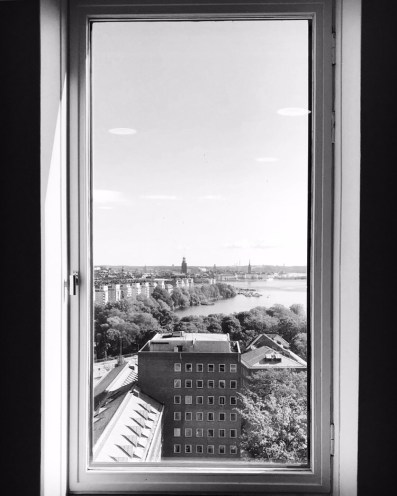
The meeting room’s window

Stockholm, September 2018

I’m sitting in a meeting room, wearing a dark blue suit with a white shirt without a tie. Actions plans are discussed, a budget plan is proposed and a connection with our international partners is made. My colleagues speak and even though I am listening, my view is lost in one of the big windows. We are sitting in one of the tallest buildings of the city (which if you compre it to any industrial city is not that tall) in one of the upper floors and due to the flatness of the skyline and the lack of ugly glass skyscrapers I am able to see how the city spreads with its black metal roofs through the islands that and beyond them the archipiélago  seems not to end in the distance.

A plan is made, a critical path is analysed, someone is worried about the deadlines, the schedule is changed, their voices fade as my sight is lost between the boats sailing, the blue trains going back and forth in between the islands, and the people that look like little dots. I’m sitting here, but I am not really here. I have pursued to be here, but a side of thought of be somewhere.

I comment, collaborate, propose and discuss, yet I am a preconceived version of myself. The water reflects the white clouds and the birds fly down and up the water hunting for distracted fishes, while a part of my consciusness flies with them, away from what I call my life, away from who I am supposed to be.

Hands are shaken, roles are proposed, and everybody leaves the meeting room. As I walk through the corridor I look once again into the distance behind the glass window. I’m here but I am also there, because that is how I have always been, nowhere.

Beyond the desert plateau

Real de Catorce, May 2016

I ride at dawn passing by the peaks which mark the limit of the town, leaving behind our group, leaving behind the familiar into the dusty planes that extend beyond the horizon. The air still fresh from the dying night hits my face as I ride knowing I am going nowhere and my horse gallops at a firm phase through the bushes.

I pass by the old railroad station, far into the plateau, far away from any road. The sun rising up in the clear sky, warming the soil and with it the sounds of the animals hidden in the nature, singing like a coordinated orchestra with a feral touch. There were no signs or men, just the face of nature and its creations dwelling in the bushes and through holes along the soil.

I ride along the high mesas and the ground resounds under my horse hooves and he gallops faster as I slightly press him with my boots. Our blood heated as the sun warmed our skin and our mouths dry up and our breath becomes heavy. I turn into the old hill road and he goes anxious as if he knows our time is coming to an end and I know that what I was seeking to discover in the desert was a think that I’d always knew; that our shadows would never be one again and that my future was beyond the distance under a different sky, in which we will not ride again.

I ride through the old mining compound, silent and abandoned through the times of the revolution and I take down the mounting of my horse and we both drink water from the small pound under the ruins of the old mill. I look at his big brown eyes that seem calm, yet he looks at me quietly as if he know my heart was full with sadness. We stand there without making much sound as the cold breeze of the nearby mountains cools down our bodies and I prepare the mount again to head up into the old road.

We encounter cowboys and their cattle, jeeps full of tourists ready to venture in search of peyote, and later on I hear the bell of the church marking the entrance back into civilization and I ride back to the old hacienda, where my friends and family are having breakfast. I leave the horse at the stable with the other horses and he looks back at me from the fence quiet and still as if he knew we will not ride again, as if he was saying goodbye.

——

Stockholm , July 2018

Goodbye old friend.

Train ride to nowhere

I’m sitting in the restaurant car of a train. The window reflects a landscape I can’t name. It could be the mountains of the Sierra Madre, but the signs inside the carriage are written in Cyrillic, and the air is too cold for summer. I’m wearing a slim black suit, sipping a gin and tonic that tastes better than it should. My head feels ready to burst, my heart beating too fast, as if I’d just snorted two clean lines of Peruvian snow. The train is empty. Time isn’t moving; only the train is. I don’t know where it’s going, but it feels like I’ve been here before.

You’re sitting across from me in a blue dress, your hair falling over your shoulders. You stare without expression. I can almost see your sadness floating behind your eyes. I reach for your hand, but you slip away and laugh instead, lifting a glass of red wine that wasn’t there a moment ago. The train begins to move faster. The cold turns into heat, unbearable and slow, and yet you seem untouched. The world outside shifts into an endless desert, pale and trembling under the sun.

From somewhere, “I Wanna Be Your Dog” by Iggy Pop starts playing through the speakers. You laugh again and take my hand, this time with a grip that burns. I want to kiss you, but I can’t move. My body feels like glass. You’re still laughing when confetti begins to fall from nowhere, spinning in the air like dying snowflakes. The train races forward, and the desert outside catches fire.

“It’s the last time,” you say, almost whispering. “But not like the other last times. This is truly the last.”

“I don’t know if that’s how it’s supposed to happen,” I tell you. “Or if I can promise it ever was.” Tears gather in my eyes, but I can’t cry. I just smile, as if smiling could make it easier.

You tilt your head and sigh. “There isn’t much to say. Things become what they were always meant to be. You should go wherever this ride takes you…with or without me.”

You rise and come closer, kiss me like you did the first time: quick, sudden, full of light. Then the confetti burns into ash. The air smells like iron and smoke.

“There are no goodbyes,” you say as you walk toward the next car, already swallowed by fire. “Only jumps into different futures that sometimes meet again.”

You step into the flames. They don’t consume you. They just absorb your shape until you disappear completely.

Now I’m alone. The train rushes into a tunnel. Fire covers everything, but it’s cold, like snow that burns without smoke. My heart hurts, but I can’t move. Darkness fills the windows. I know I can’t follow you.

I start crying because I remember—I’ve been here before. I always reach the station alone. The train breaks through the tunnel and stops. The flames vanish. I find myself in an unnamed Eastern European city, the kind that doesn’t exist on any map. I wait for the next train to arrive, though I already know it never really does.

Then I wake up. The ceiling above me is white. The bed beside me is warm, but it isn’t you. I wonder if you wake beside someone else, and if, in the quiet moment before morning, you ever think of me…or if I’ve faded, like the confetti, into the air.

I make coffee and move through the day. The world feels distant, as if it’s still shaking from the rails. By evening, the memory begins to dissolve, until it returns again, uninvited, on another nameless night when I’ll find myself back on that same train.

Maybe you’ll be there.

Maybe not

Who drinks at Björnsträdgården?

Stockholm, October 2016

The leaves on the trees slowly shifted from green to yellow-brown gradients… gathering quietly in the corners of the city. It wasn’t cold, but it wasn’t really warm either; strong winds began to sweep through the streets, and the clothes people wore changed with them. Everyone seemed to slip into a grayscale palette… and in a way, so did their faces; fewer smiles, slower steps, and one by one, the outdoor areas of bars and restaurants began to close.

I wasn’t used to such a collective change in mood caused by the weather. Back home, people didn’t really change depending on how hot or cold it was outside… but this wasn’t home, and from the moment I applied to come here, I somehow knew that the closer you are to the poles, the colder people become too.

By then, I had already formed a small group of friends from school; a mix of locals and foreigners who didn’t want to spend all their time studying. We wanted to live a little… to experience something outside the usual student routines. One evening we planned to go to a trendy rooftop bar in the old slaughterhouse district, south of the city; it would close soon due to the weather, so it felt like the right time. A friend and I decided to have a few drinks beforehand in a nearby park… the closer to the metro, the better.

We walked up Götgatan and stopped at a small park called Björnsträdgården. It had concrete stairs where people sat facing a patch of green with a playground and a skatepark in the background; it seemed like a perfectly normal place to gather.

We texted our local friends, who sounded slightly confused as to why we had chosen to drink there… yet they still agreed to come. We didn’t really understand their hesitation; what could be wrong with it? Soon after, though, we were approached by junkies asking for beer, Roma women asking for money, the girls were catcalled by young North African migrants… and a few other strange people wandered around. We left as soon as our friends arrived.

That brief episode stayed with me. I couldn’t stop thinking about how that part of town, which had always seemed decent to me, changed so abruptly once the sun went down. It wasn’t that I didn’t know my neighborhood… but rather that I hadn’t truly seen it. Somehow, the invisible had become visible; the city’s hidden face revealed itself in the half-light of evening. It gave the streets a quiet melancholy… but most people seemed to ignore it.

It was oddly fascinating to see how the beautiful and the broken coexisted in the same space; like two parallel realities brushing past each other without meeting. Every time they crossed paths, it felt as if they existed in different dimensions… the elegant blondes in Chanel coats blocking out the Roma girl asking for coins. They were there and not there at the same time; and as days passed, they became invisible to me too… as if their existence were a glitch in the fabric of the city. Their pain drifted somewhere beyond our world, too distant to matter.

Everyone kept walking with headphones on and their thoughts far away; everyone passed without looking, and in a metaphysical sense they were only shadows of something we know exists… but prefer not to recognize.

Later that year, the city invested in a new lighting system to cover the same area where we had first sat. Slowly, those people disappeared; replaced by community service officers patrolling more often. Their corners were gone… their presence erased. Their suffering was moved elsewhere, somewhere unseen; a place less unpleasant to the eye, where people could again focus on their Instagram notifications, their Tinder dates… and not on the sound of coins rattling inside a Pressbyrån coffee cup