The Gospel of the Stranger
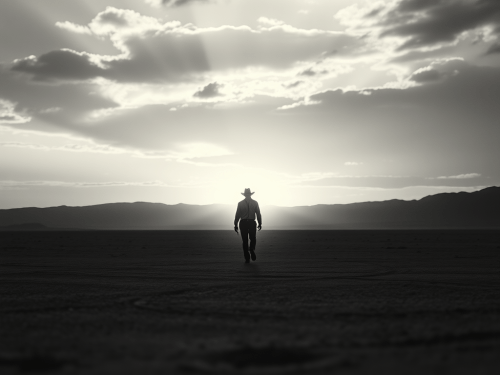
He’s just a man, or he pretends to be one. He’s got one of those faces you forget on your way home, the kind that look like someone’s cousin or that someone itself. You will pass him at the market in Juarez, maybe, or going out of church after Sunday mass, though nobody remembers him going in. Later your uncle will mention a man he drank with after the harvest, and you’ll realize, slowly, that he’s describing the same face. It’s the voice that stays . It’s too smooth and the words he chooses come from another time; the kind of words nobody speaks anymore except maybe the priests and the dead. You will find him charming, even handsome. People listen to him. He knows the name of the stars on the night sky and the name of saints and their tragedies. When he meets a poet he recites verses of old masters by memory. When he meets a veteran he pours the mezcal himself and remembers battles the veteran had forgotten he’d fought.
But if you stand close enough, and pay a little attention; something shifts. The air around him feels older than it should. His voice carries echoes you can’t quite place. You realize, slowly, that while you remember seeing him, you cannot remember him arriving. And when you ask others, those who swear they met him before, their stories never quite line up. He was here yesterday. He was here a decade ago. He was there when your grandfather was a boy and the old haciendas still had their walls. He has always been here. He has never stayed.
His eyes catch light but don’t hold it. They are dark; not brown, but more like river stones after the rain, or the black inside a rifle barrel. His gaze lands on you like a hand checking a fruit for bruises. You have the unsettling sense that he isn’t really looking at you but through you, at some shape you throw that you’ve never been able to see yourself.
The stories about him don’t match, but they rhyme. A man in Nogales swore he’d crossed the desert on foot in the dry season, no water, no shade, and walked into the cantina like he’d come from the corner. Someone’s aunt said she saw him in a judge’s coat at a trial in the capital, and someone else, the same summer, drinking in a jail cell in Jalisco with her brother — no chains, no guard, no reason to be there. You stop asking after a while. The stories are always like that. Too specific to be lies. Too impossible to sit next to each other.
They say he’s been useful to some. That he stood beside a caudillo the night before the land was signed away, and the man signed anyway, smiling, and shot himself before morning. That he taught a cristero how to pray in a way that made the bullets slower, and the man walked out of three ambushes before he walked into the fourth on purpose. That he gave a woman in Reynosa an answer she’d been chasing since her son didn’t come home, and she stopped speaking to her sister the week after. The stories don’t always agree on what he gave. They agree on the shape of the after. Something got made. Something got taken.
What he takes is always one thing: the thing that used to make you hesitate. Your father’s last words. The face of the first man you killed. The prayer your grandmother taught you. He leaves you free; free to act without the friction of doubt, free to build without the burden of guilt. And oh boy you will build. Higher and faster than you ever imagined. Until you realize that what you’ve built has no doors, and you’re already inside it.
A secret costs you a friend’s name. A fortune costs you the taste of the beans your mother cooked when there was nothing else. He leaves you with power. With knowledge. With everything you asked for, and no memory of why you wanted it in the first place.
I used to think the people telling me these things were exaggerating. Grief does that. So does mezcal. But the details are wrong the way real things are wrong, off by a Tuesday, off by a name, off by the color of a horse. Nobody invents a story and gets the weather right by accident.
And sometimes I wonder if he wonders too. Whether his purpose is only to unmake. He has witnessed the things that grow in his tracks. Marigolds on the graves he didn’t dig. Towns rise on the bones he left behind. Creation isn’t his aim, yet it follows him as surely as zopilotes follow the wounded. Perhaps that is why he smiles, on the rare occasions he loses. In loss he isn’t ended. He just waits for the next dry season to come.
Every word he says has purpose. Every silence gives his ideas time to settle, like dust in a room after someone’s left it.
They say there are whispers of him in every language the country speaks — in Spanish, in Náhuatl, in the old highland tongues nobody writes down anymore. They say he has no home and has never needed one. That he’s eaten at the general’s table and at the table of the woman who cooks for the general’s dogs, and neither meal made him full.
Some men go looking for him. He is not to be summoned, not to be found.
Wherever men speak of revenge, of land, of gold, or glory — he’s already there.
I have seen him. And I know you have too. He was there the moment you called it necessary. When the cost of your ambition fell on someone else, and you let it fall. He offered his hand, but it was your finger on the trigger. And by the time you realized it wasn’t what you really wanted, you were already at his service.